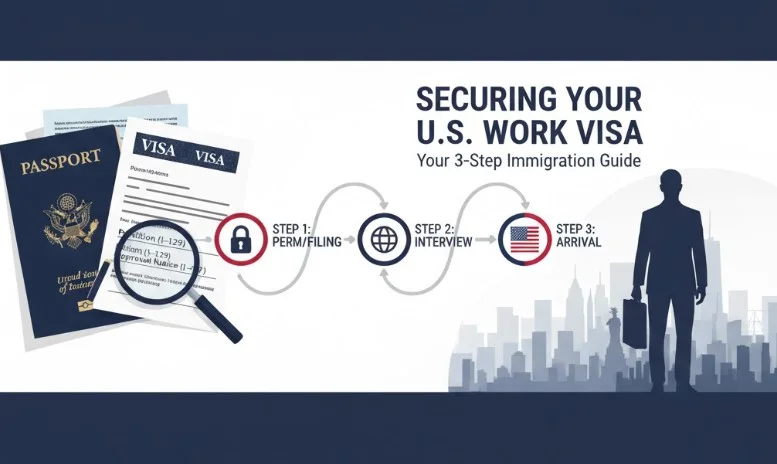
Understanding the initial, critical steps to secure a work visa for immigration to the USA begins with a crucial distinction: are you seeking a temporary (non-immigrant) work visa or a permanent (immigrant) employment-based visa, which leads to a Green Card?
Temporary visas, like the H-1B or L-1, allow you to work in the U.S. for a specified period and often require proof of intent to return to your home country. Permanent visas, such as the EB-1 or EB-3, grant you authorization to live and work in the U.S. indefinitely.
Regardless of the category, the fundamental first step is nearly always the same: securing a sponsoring U.S. employer and an official job offer. Without this, the visa application process cannot begin, as U.S. immigration is employer-driven.
Your prospective employer acts as the petitioner, submitting the necessary paperwork to the U.S. Citizenship and Immigration Services (USCIS) on your behalf, the beneficiary.
Securing a work visa for the USA represents a monumental and often life-changing step toward living and working in one of the world’s most dynamic economies.
This journey, while complex, is absolutely achievable with meticulous planning and a clear understanding of the steps to secure a work visa for immigration to the USA. The vast array of visa categories, each with its unique requirements and application procedures, can feel overwhelming.
However, by breaking down the process into clear, manageable stages—from securing a job offer to attending your consular interview—you can navigate the path to professional success in the United States with confidence. This comprehensive guide will illuminate the entire process, preparing you for every stage of your immigration journey.
Phase I: Laying the Foundation – The Employer Petition
The journey toward securing a work visa for immigration to the USA is entirely contingent upon the successful completion of the initial stage: The Employer Petition. This phase is the responsibility of the prospective U.S. employer and serves as the legal backbone of your entire visa application.
It is where the U.S. government, through the Department of Labor (DOL) and U.S. Citizenship and Immigration Services (USCIS), verifies that the job is legitimate, the foreign worker is qualified, and the employment does not adversely affect the U.S. labor market. Mastery of these initial steps to secure a work visa for immigration to the USA is non-negotiable for success.
Securing an Official Job Offer from a U.S. Sponsor
The absolute first action in the steps to secure a work visa for immigration to the USA is obtaining a formal, written job offer from a U.S. entity that is willing to act as your sponsor (the Petitioner).
This isn’t merely a verbal agreement; it must be a solid, detailed offer of employment that outlines the specific job title, responsibilities, required qualifications, and proposed salary. For immigration purposes, the job itself must meet the requirements of a specific visa category.
For instance, if the employer plans to sponsor an H-1B visa, the job must inherently be a “specialty occupation,” meaning it requires the theoretical and practical application of a body of highly specialized knowledge and a minimum of a bachelor’s degree or its equivalent in a specific field.
Without this formal, visa-compliant employment relationship established, no petition can be filed, making this job offer the essential cornerstone of the foundation.
Determining the Appropriate Work Visa Classification
Once a job offer is secured, the sponsoring employer must, often with the guidance of an immigration attorney, select the correct visa classification.
This determination is a critical step, as the requirements, processes, and timelines vary drastically between temporary (non-immigrant) and permanent (immigrant) visa categories.
For temporary work, common options include the H-1B for specialty occupations, the L-1 for intra-company transferees (managers/executives/specialized knowledge workers), the O-1 for individuals of extraordinary ability, and the E-2 for treaty investors/employees.
For permanent residency, categories like EB-1 (extraordinary ability, outstanding professors/researchers, multinational executives), EB-2 (advanced degree professionals/National Interest Waiver), or EB-3 (skilled workers/professionals) may be chosen.
The chosen classification dictates every subsequent filing, fee, and required document in the steps to secure a work visa for immigration to the USA.
Completing the Labor Condition Application (LCA) for Non-immigrant Visas
For certain non-immigrant categories, most notably the H-1B, the employer must first satisfy a labor compliance requirement by filing a Labor Condition Application (LCA), Form ETA-9035, with the Department of Labor (DOL). This step is a critical protective measure designed to safeguard U.S. workers.
In the LCA, the employer makes four key attestations:
- that they will pay the foreign worker at least the actual wage paid to other similarly employed workers or the local prevailing wage for the occupation, whichever is higher
- second, that the employment will not adversely affect the working conditions of U.S. workers
- third, that there is no strike or lockout in the occupational classification at the place of employment
- and finally, that notice of the filing of the LCA has been provided to the employees.
The DOL reviews the LCA for completeness and obvious errors, and upon certification, the employer has the required document to proceed with the USCIS petition.
Conducting the H-1B Electronic Registration and Lottery
Before the full petition can be filed for cap-subject H-1B visas, the employer must participate in an electronic pre-registration process. This step was introduced to manage the overwhelming demand for the H-1B category, which is subject to an annual limit (cap).
During a designated registration window, typically in March, the employer electronically submits basic information about the company and the prospective employee to USCIS.
USCIS then conducts a random selection, or lottery, from the submitted registrations. Only those employers whose registrations are selected in this lottery are permitted to move forward and file the complete Form I-129 petition.
This random selection is one of the most unpredictable and stressful initial steps to secure a work visa for immigration to the USA for countless high-skilled workers each year.
Executing the PERM Labor Certification for Immigrant Visas
For most employment-based permanent residency categories, specifically the EB-2 and EB-3 (unless waived, as in the National Interest Waiver), the employer must successfully complete the Program Electronic Review Management (PERM) labor certification process with the DOL.
This is a much more intensive recruitment and attestation process than the LCA. The employer must demonstrate, through a rigorous, good-faith recruitment campaign conducted over a specific regulatory period, that there are no minimally qualified U.S. workers able, willing, and available to accept the job in the metropolitan area of intended employment.
This involves placing job ads in newspapers, posting notices internally, and utilizing other specified recruitment methods.
The employer then certifies to the DOL that the recruitment was unsuccessful. Only upon DOL approval and certification of the PERM application (Form ETA-9089) can the employer proceed to the next step of filing the immigrant petition with USCIS.
Filing the Petition for a Non-immigrant Worker (Form I-129)
This is the central filing document for all temporary work visas. After completing all prerequisite labor requirements (like the certified LCA for H-1B, or gathering proof of the corporate relationship for L-1), the U.S. employer officially files Form I-129, Petition for a Non-immigrant Worker, with USCIS.
The I-129 is accompanied by a substantial packet of evidence, which includes the certified LCA/corporate documents, a letter detailing the job offer, evidence of the employee’s qualifications (degrees, transcripts, professional experience), and the required government filing fees.
The purpose of this step is for USCIS to approve the employment and classify the foreign national in the appropriate non-immigrant status, officially validating this crucial stage of the steps to secure a work visa for immigration to the USA.
Filing the Immigrant Petition for Alien Worker (Form I-140)
For those pursuing permanent residency, the employer files Form I-140, Immigrant Petition for Alien Worker, with USCIS. This filing occurs after a successful PERM labor certification (if required) or simultaneously with it in cases like the EB-1 category.
The I-140 is the official request for USCIS to recognize the foreign national’s eligibility for a specific permanent resident visa classification (e.g., EB-1, EB-2, EB-3). The filing includes the approved PERM certificate, or evidence to establish the foreign national’s extraordinary ability/advanced degree/national interest claim.
USCIS reviews this petition to confirm that the employee meets the regulatory criteria for the immigrant classification being sought, a key differentiator from the temporary I-129 process.
USCIS Processing, Request for Evidence (RFE), and Notice of Action
Upon submission, the filed petition (either I-129 or I-140) enters the USCIS processing queue. The standard processing time can vary dramatically based on the service center and the volume of cases.
To expedite this wait, the employer may opt for Premium Processing, which guarantees USCIS will take action (approval, denial, or Request for Evidence) within a short window, typically 15 calendar days, for an additional substantial fee.
A Request for Evidence (RFE) is a common occurrence where USCIS asks for more supporting documents or clarification on a specific legal point. The employer must provide a strong, detailed, and timely response to the RFE.
The final, much-awaited outcome of this phase is the Notice of Action, Form I-797. This official document signifies the approval of the petition, concluding the employer’s foundation-laying stage of the steps to secure a work visa for immigration to the USA and paving the way for the employee’s consular application.
Phase II: The Consular Processing Stage
The Consular Processing stage, often referred to as Phase II for those outside the U.S. seeking a visa, begins after U.S. Citizenship and Immigration Services (USCIS) has approved the initial petition (like the Form I-140 for an immigrant work visa or the Form I-129 for certain non-immigrant work visas like H-1B, resulting in a Form I-797 Approval Notice).
This phase is managed primarily by the U.S. Department of State (DOS) through the National Visa Center (NVC) and the U.S. Embassy or Consulate in the applicant’s home country.
NVC Case Creation and Welcome Letter
The consular process is officially kicked off when USCIS forwards the approved visa petition to the Department of State’s National Visa Center (NVC). The NVC acts as a liaison, pre-processing the case before it is sent to a U.S. Embassy or Consulate for the interview.
The very first step at the NVC is the creation of a case file within their system, which typically takes a few weeks after USCIS approval. Once the case is created, the NVC sends a Welcome Letter via email or physical mail to the applicant (and the petitioner or agent, if one was designated).
This letter is critical as it contains the NVC Case Number and the Invoice ID Number, which are essential for logging into the Consular Electronic Application Center (CEAC) to track the case status, pay fees, and submit the necessary documents.
Payment of Required Fees
Following the receipt of the Welcome Letter and the necessary login information, the applicant must then pay the required fees through the online CEAC portal.
For most employment-based immigrant visas (Green Cards), this involves two primary fees: the Immigrant Visa Application Processing Fee (for Form DS-260) and the Affidavit of Support Fee (Form I-864).
For non-immigrant work visas (like H-1B or O-1), the primary fee is the Machine Readable Visa (MRV) fee, though the exact amount and payment method can vary by country and visa type.
The NVC will only continue processing the case after these fees have been successfully paid and the payment has been processed and acknowledged, which can take several business days. Failure to pay the fees promptly can lead to delays in the overall processing timeline.
Submission of the Online Visa Application (Form DS-260 or DS-160)
The applicant must complete the required online visa application form. For immigrant work visas (Green Cards), this is Form DS-260, the Immigrant Visa and Alien Registration Application, which is completed online through the CEAC portal.
For non-immigrant work visas (e.g., H-1B, L-1, O-1), the applicant must complete and submit Form DS-160, the Online Non-immigrant Visa Application. Both forms are comprehensive and require detailed information about the applicant’s background, education, work history, travel history to the U.S., and security information.
Accuracy is paramount, as any inconsistencies with the initial petition documents (Form I-140 or I-129) can lead to delays or even denial at the interview stage. Once submitted, the applicant must print the confirmation page with the unique barcode, which is a mandatory document for the visa interview.
Collection and Submission of Civil and Financial Documents
After paying the fees and submitting the online application, the NVC requires the collection and submission of various supporting documents, which the NVC refers to as “civil documents.”
These typically include the applicant’s birth certificate, passport bio page, marriage and/or divorce certificates (if applicable), police certificates from every country lived in for more than 12 months since the age of 16, and court/prison records (if applicable).
For immigrant visas, the petitioner must also submit financial support documents, such as the Affidavit of Support (Form I-864), along with supporting evidence like tax returns and W-2 forms, to prove they can financially support the applicant and that the applicant will not become a public charge in the U.S.
All documents not in English must be accompanied by certified English translations. These documents are usually submitted electronically as scanned files to the NVC through the CEAC portal for review.
NVC Document Review and Documentarily Qualified Status
Once all the required fees, forms, and civil/financial documents have been electronically submitted to the NVC, the NVC staff will conduct a thorough review to ensure everything is complete and correct.
This process can take several months, as the NVC must ensure that the applicant has satisfied all documentary requirements. If documents are missing, incorrect, or incomplete, the NVC will issue a checklist and the applicant will need to correct and re-submit the requested documentation, which starts the review process over again.
When the NVC determines that all the necessary documents have been submitted and are acceptable, they will inform the applicant that their case is “Documentarily Qualified” (DQ).
This status signifies the end of the NVC processing stage, and the case is now ready to be scheduled for an interview at the U.S. Embassy or Consulate.
Visa Interview Scheduling and Medical Examination
Upon obtaining Documentarily Qualified status and when an immigrant visa is available (for certain quota-based immigrant visas, based on the priority date in the Visa Bulletin), the NVC will work with the designated U.S. Embassy or Consulate to schedule the final visa interview.
The applicant will receive a formal appointment letter, often called the Interview Letter, which contains the date, time, and location of the interview.
Around this time, the applicant is also required to undergo a mandatory medical examination with an authorized panel physician in the country where the interview will take place.
The medical exam is a critical final step, and the physician will forward the completed medical forms, often in a sealed envelope, directly to the U.S. Embassy or Consulate for the consular officer to review during the interview.
Attending the Consular Interview
The visa applicant must attend the final interview at the U.S. Embassy or Consulate at the scheduled date and time. This is arguably the most critical step in the entire consular processing journey.
The applicant must bring their current passport, the DS-160 or DS-260 confirmation page, the Interview Appointment Letter, the sealed envelope from the panel physician (if provided to the applicant), and all original civil documents (even those previously submitted electronically).
A Consular Officer will review the application, supporting documents, and the results of the medical examination. The purpose of the interview is to verify the information in the application and to determine the applicant’s eligibility for the visa under U.S. immigration law, specifically looking for any grounds of inadmissibility.
The applicant should be prepared to answer questions about their job, qualifications, family, and intentions in the United States.
Final Visa Adjudication and Issuance
If the Consular Officer finds the applicant eligible for the visa after the interview, the visa application is approved. The officer will typically take the applicant’s passport and notify them of the next steps for receiving the visa.
For immigrant visas, the officer will issue an Immigrant Visa packet, which is a sealed envelope containing all the applicant’s supporting documents that must not be opened and must be presented to a U.S. Customs and Border Protection (CBP) officer upon entry into the United States.
For non-immigrant visas, the visa foil (sticker) will be placed directly into the applicant’s passport. Once the visa is issued, the applicant is officially permitted to travel to the U.S. and request admission for their work-related purposes.
If the visa is denied, the Consular Officer will provide the applicant with a refusal letter explaining the reasons and whether the denial can be overcome with additional information or a waiver application.
The Future of Work Visa for Immigration to the USA
The future of work visas for immigration to the USA is shaped by a complex interplay of economic necessity, technological advancements, and shifting political landscapes.
The overarching trends point toward increased scrutiny, a focus on high-skill labor, and potential for regulatory overhauls driven by both national security and economic growth concerns.
Increased Scrutiny and Evolving H-1B Regulations
The primary temporary work visa for high-skilled labor, the H-1B program, will continue to be a focal point for regulatory change. Future trends suggest a move toward stricter oversight, potentially prioritizing higher-wage or more specialized roles.
For instance, the H-1B lottery system has been reformed to a “beneficiary-centric” model to reduce system abuse.
Furthermore, a new administration could implement policies, such as a preference for a wage-based selection system or significantly increased application fees, which would prioritize top talent and add considerable cost and complexity for employers, particularly smaller start-ups, who would then need to ensure their hiring practices and job roles are thoroughly justified to avoid high denial rates seen in previous restrictive periods.
The Driving Force of AI and High-Tech Demand
The explosive growth in Artificial Intelligence (AI), machine learning, cybersecurity, and cloud computing is fueling an unprecedented demand for foreign talent, particularly in STEM fields.
U.S. companies, especially tech giants and specialized start-ups, will increasingly rely on work visas to fill these critical skills gaps that the domestic talent pipeline cannot fully meet.
This surging demand, however, creates a tension: on one hand, there is a clear economic need for workers in AI-related roles, and on the other, political pressure to ensure that American workers are not displaced.
This dynamic is likely to push the government to streamline pathways for international students with advanced degrees in these fields, such as via Optional Practical Training (OPT), to transition to H-1B status.
Need for Modernized, Flexible Visa Pathways
The current employment-based immigration system, with its rigid caps and decades-old structure, is widely considered outdated and ill-equipped to meet modern labor market needs across all skill levels.
There is a growing consensus among policy analysts for Congress to reform the legal immigration system to make it more flexible, responsive, and data-driven.
Proposals suggest lifting or eliminating caps on both temporary visas (like H-1B and H-2B) and employment-based green cards to clear massive backlogs and allow the number of visas to adjust based on real economic demand.
Innovative ideas like a “Bridge Visa” have been proposed to create a more direct, inclusive pathway from temporary worker status to permanent residency for workers across all skill levels.
The Pressure to Address Labor Shortages and Demographic Changes
The U.S. is facing a demographic challenge with an aging population and a decelerating growth in the native-born workforce, which is placing increasing pressure on a smaller working-age population to support a growing number of retirees.
As a result, immigration is becoming an ever more essential driver of labor force growth and economic vitality, with immigrants offsetting workforce declines.
To maintain economic growth and staff key industries like healthcare, construction, and hospitality, the demand for both high-skilled and year-round, middle- and lower-wage workers will continue to push for the expansion of legal pathways.
Therefore, the long-term trend suggests that policymakers will eventually need to create solutions to replace a shrinking domestic workforce and prevent severe economic contraction.
Politicization and Policy Uncertainty
Work visa policy will remain a deeply politicized issue, leading to continued uncertainty for both employers and foreign nationals. Future policy direction will largely depend on which administration and Congress are in power, leading to cycles of restriction and relaxation.
Restrictive administrations tend to increase denial rates, processing delays, and introduce burdensome regulations like raising wage requirements or imposing new, high fees. Conversely, administrations focused on expanding legal immigration may prioritize clearing backlogs and supporting legal pathways.
This political volatility necessitates that employers adopt a proactive and strategic approach to compliance and sponsorship, as the landscape for employment-based immigration can shift rapidly through executive action and regulatory changes, even without major legislative reform.
Conclusion
The path to securing a work visa for immigration to the USA is a structured process that demands preparation, patience, and precision. It is an intricate collaboration between the sponsoring employer (petitioner) and the talented foreign worker (beneficiary).
By carefully mastering the steps to secure a work visa for immigration to the USA—from the employer’s initial petition to your final consular interview—you are positioning yourself for success.
While the process may seem long and the legal details complex, the opportunity to contribute your skills and expertise to the U.S. economy makes the effort worthwhile. For such a high-stakes undertaking, consulting with a qualified immigration professional is always recommended to ensure compliance and maximize your chances of realizing your goal of working in the United States.